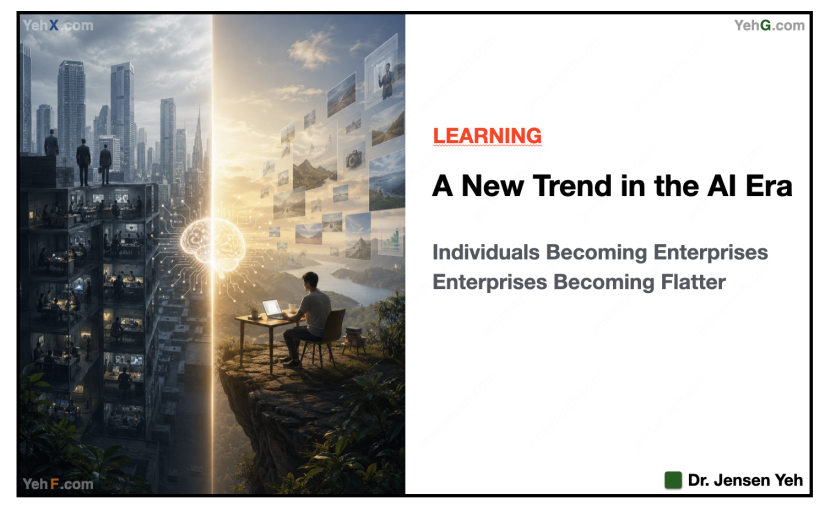
AI is not only changing workflows or the content industry. It is reshaping the organizational structure of the entire world. In the past, many capabilities were highly concentrated in large companies and platforms.
But now, AI is beginning to release some of those capabilities back to individuals. If you are a physician, researcher, creator, or independent professional, you can now use AI to accomplish things that previously required a small company, a media team, or an entire organization.
Over the past decade, I have felt the world changing very quickly. We seem to be moving toward a future where individuals become more enterprise-like, while enterprises become flatter.
In that future, the most important question may no longer be who has the most traffic. It may be: Who can leave behind something trustworthy, searchable, and durable?
Individuals Are Becoming More Enterprise-Like
For the past few decades, we have often associated success with large organizations.
The bigger the hospital, the greater the influence.
The larger the company, the stronger the competitiveness.
Media companies needed editors, designers, marketers, and distribution teams.
The spread of knowledge also depended heavily on large platforms and institutions.
But after AI became more widely available, I have increasingly felt that a new trend is emerging:
Individuals are becoming more enterprise-like, while enterprises are becoming flatter.
In the past, if a physician, researcher, or creator wanted to build their own knowledge system, it was extremely difficult.
You might have needed a web developer, designer, editor, marketing team, and a large amount of time and capital.
Many things were not impossible for individuals.
The problem was that the barrier to entry was too high.
Things that once required an entire team can now, at least in their early form, be done by one person working with AI.
So AI may not be changing only efficiency.
It may be redistributing organizational capability.
In the past, many capabilities were concentrated inside large companies.
Now, AI is lowering many barriers and allowing individuals to possess a level of output capacity that once belonged only to small enterprises.
Simply put:
AI strengthens individual capability.
Take website building as an example.
In the past, building a website required a learning curve for most people. You had to understand hosting, domains, WordPress, layout settings, basic SEO, and countless small details that looked simple but were actually tedious.
But now, with AI assistance, it is possible to build the basic prototype of a website within one or two hours.
This does not mean everyone will become a web developer.
It also does not mean every website will be well built.
But it does mean one thing:
Tasks that individuals previously could not do, or found very difficult to do, are becoming much easier.
I think of it with a simple analogy.
In the past, it might have looked like this:
Website-building ability: 0
Writing ability: 60
Total: 60 points
Now it may become:
Website-building ability: 0
Writing ability: 60
AI assistance: greatly increased execution speed
Total: 60 to 100 points
Why 60 to 100 points, instead of automatically becoming 100?
Because AI is still only a tool. How well you understand and use AI determines how far you can go.
People who know how to ask questions, make judgments, revise, and integrate ideas will be able to go much further with AI.
But if someone lacks basic judgment, AI may simply help them produce a large amount of ordinary content very quickly.
So AI is more like an amplifier of capability. It is not a generator of capability from nothing.

Enterprises Are Becoming Flatter
As individual capability is amplified by AI, companies are also changing.
When AI enters an organization, the first things to be transformed are often not the core experts.
Instead, AI first changes the work of organizing noise and producing written materials.
Meeting summaries, reports, document processing, data searching, first drafts of presentations, basic customer service — these were once tasks that required many people and layers of coordination.
Now, AI can complete many of them quickly.
As a result, many companies are beginning to reduce middle management, shrink team sizes, increase the productivity of each individual, and move toward leaner, flatter organizations with higher talent density.
So if you are an individual contributor who knows how to use AI well, your personal capability may increase significantly.
You may stand out and become the kind of person leaders want to rely on.
At least for now, you may be less likely to be laid off. But in the future, who knows?
Maybe one day you will be replaced by the very AI workflow you helped optimize.
In the past, large organizations gained advantage through scale.
But as AI lowers the cost of information processing and content production, many internal workflows that used to depend on layers of manpower may be redesigned.
This is what I mean by “enterprise flattening.”
Companies will not disappear because of this.
Large organizations will not become irrelevant.
In medicine, manufacturing, regulation, education, research, finance, and many other fields, we still need systems, teams, and scale.
No matter how lean an organization becomes, someone still has to sign off, take responsibility, be reviewed, take the blame, and perhaps even get sued.
That is just how the real world works.
But AI forces companies to ask a few important questions:
Which tasks truly require humans?
Which tasks are merely information relay stations?
Which organizational layers existed only because the tools of the past were insufficient?
When AI changes workflows, organizations naturally change with them.
My Personal Reflection
For me, this is not just a technological observation. It is also a very real personal experience.
I first attended a personal branding workshop by InnovaRad. Later, I gradually learned how to build my own website.
Ten years have passed.
I did not become a web developer, and I would not claim to be highly technical.
But because of those experiences, I gained a basic understanding of website building, SEO, content structure, and search logic.
In the era before AI, many things had to be learned slowly and manually.
Making one image used to take a long time.
Writing one article required repeated revisions until I was satisfied.
Studying website structure, learning SEO, and practicing public speaking all required a great amount of effort.
Many things were not learned all at once.
They were accumulated through doing, making mistakes, revising, and doing again.
At the time, these learning experiences seemed scattered.
Sometimes I even wondered whether I was making things unnecessarily difficult for myself.
But looking back now, I am grateful that I went through that pre-AI period.
Because after AI appeared, what I felt was not:
“AI made me strong from zero.”
What I felt was:
“AI started amplifying the abilities I had accumulated over the past ten years.”
If you know how to write, AI can help you expand your ideas faster.
If you understand design, AI can help you generate visual drafts more quickly.
If you understand SEO and website logic, AI can help you build system architecture faster.
In the end, AI often amplifies the foundational abilities that already exist within a person.
Because of AI, more and more people are gaining wings.
Some people are rapidly producing products, images, writing, websites, and outputs we have never seen before.
When an ordinary person like me sees so many people around me using AI to create at such speed, anxiety is inevitable.
Feeling anxious is normal. I feel it too.
But whenever that anxiety appears, I try to pause and ask myself one question:
What will not change in the next ten years?
What might not even change in the next thirty years?
Once I think in this direction and slowly find my own answer, I feel more grounded.
AI can amplify capability.
But some things still require time to accumulate.
Real-world experience.
Professional judgment.
Long-term credibility.
A record of truly helping people.
And the traces left behind by a person who continues to face problems and solve them over time.
No matter how powerful AI becomes, it cannot generate things that require time to create.
Conclusion
Many people assume that in the AI era, the most important thing is who can generate content the fastest, who can produce the most short videos, or who can capture the most traffic.
But I increasingly believe that what will become truly scarce in the future is different.
Real-world experience.
Long-term professional accumulation.
Verifiable identity.
Professional credibility.
And the knowledge context a person has built over time.
This is also why Google has increasingly emphasized E-E-A-T in recent years: Experience, Expertise, Authoritativeness, and Trustworthiness.
Because in the age of AI search, content will become more abundant than ever.
Trustworthy sources, however, will become more important.
I do not believe the future will belong only to individuals.
Nor do I believe companies will disappear.
But the world is slowly moving away from large, rigid organizations and toward smaller, highly trusted, highly leveraged knowledge nodes.
Using the language of blockchain, this is a movement from centralization toward decentralization.
But history moves in cycles.
Decentralization may eventually lead to new forms of centralization.
Then the cycle repeats.
The world often swings between the two and eventually forms a new balance.
AI is accelerating this entire cycle.
Therefore, for individuals, the most important thing may be to accumulate something that truly belongs to them.
Personal achievements.
Professional works.
A personal website.
A knowledge system.
Or even an organization of their own.
Even if you work inside a large company, it may still be worth asking:
Am I spending my time building something that can eventually become my own asset?
Or am I simply standing on a production line, helping the company manufacture products and profits while losing track of my own direction?
A person may live for thirty years, fifty years, or even longer.
But whether a company, platform, or algorithm can remain stable for more than thirty years is far less certain.
So perhaps what truly matters in the future is leaving behind something that can be trusted, searched, and preserved by time.
In the AI era, we should learn to run ourselves like a company — and deliver to the world something that only we can create.
— 葉峻榳醫師|Dr. Jensen Yeh|YehG.com
Learn More About Me → YehG.com
Dr. Jensen Yeh is a metabolic and endocrinology specialist based in Taiwan, with over a decade of clinical practice and a parallel career in personal branding, digital assets, and medical education.
Digital Hub · YehG.com
Personal Blog · YehX.com (in Chinese)
Medical Blog · YehF.com (in Chinese)